Table of contents
- Why is gold falling? Oil and inflation
- Fed rate hike odds and what they mean for gold
- What's still supporting the gold price
- Gold and the economic calendar: the week ahead
- XAUUSD support and resistance levels
- Gold price FAQ
- Trade gold with Xalp Global Markets
- Partner with us
- About the author
Why is gold falling? Oil and inflation
Brent is back above $110 a barrel. Attacks on ships around the Strait of Hormuz, Red Sea shipping risk and threats to Saudi oil sites have all pushed crude higher. Expensive oil means sticky inflation. Sticky inflation means higher interest rates for longer. And gold pays no interest, so when rates go up, holding it costs more.
Every time talks over Hormuz look like they're making progress, oil dips and gold gets some breathing space. Every time they stall, the pressure comes back.
Fed rate hike odds and what they mean for gold
After hot September inflation numbers, the market is pricing roughly a 90% chance the Fed raises rates in December. Very few expect a move next week, but the tone of the meeting matters. US 10 year yields are above 5% and the dollar index is steady around 101.8. Neither helps gold.
What's still supporting the gold price
Central banks haven't stopped buying. China's central bank added 23 tonnes in September, its biggest month since October 2023, and 63 tonnes over the third quarter. That's 23 months in a row. This is the buyer that put a floor under gold on the way up, and it's still there.
US data is also starting to crack. Pending home sales just hit their lowest level since records began in 2001, and housing starts came in well short. If the economy cools faster than the Fed expects, rate hike bets come off the table, and that's when gold tends to bounce hard.
Gold and the economic calendar: the week ahead
All times Dubai.
Wednesday 28 October, 22:00: Fed rate decision, then the press conference.
Thursday 29 October, 16:30: US GDP and PCE inflation, the Fed's favourite inflation measure, both at once.
Thursday 29 October: ECB rate decision.
Every day: headlines on Hormuz and the oil price.
Expect spreads to widen around the Fed and the data. They do at every broker.
XAUUSD support and resistance levels
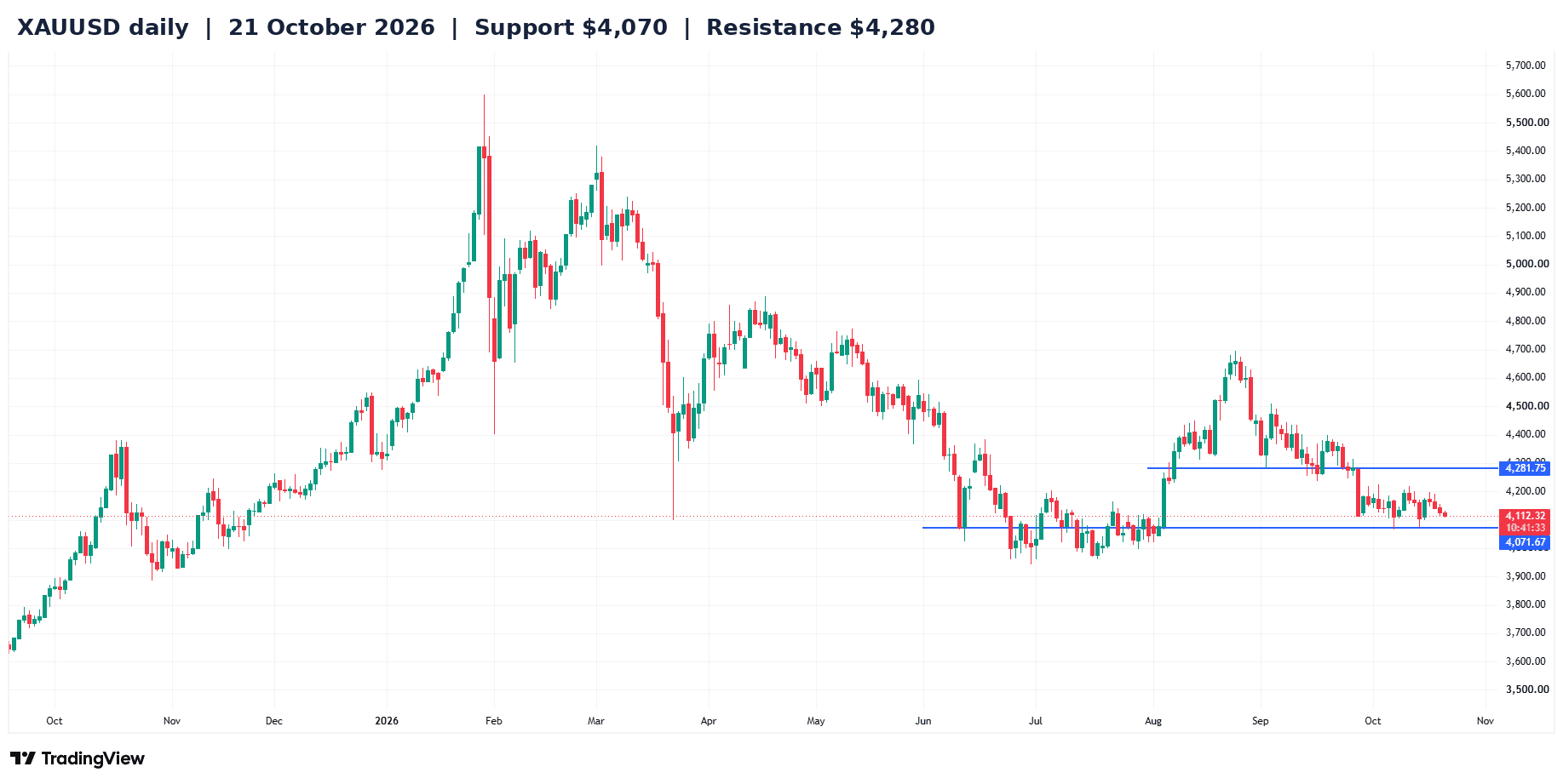
Support: $4,100 first. Below that, $4,070, the floor that held in June, July and again this month. Then the big round number at $4,000.
Resistance: $4,150 to $4,160, then $4,200 to $4,230. Above that, $4,280 is the level gold broke down from at the end of September. Back above there and the selling is over for now.
Gold was near $4,175 on Monday and $4,115 by Wednesday, so moves of this size can come quickly. A Fed that sounds less aggressive, or a deal on Hormuz, could take it back through $4,160 fast. A hot PCE number and more oil strength puts $4,000 in play.
Either way, this is a market that's moving, and moving markets are where traders make their decisions.
Gold price FAQ
Will gold go up or down before the Fed? Nobody knows for sure. The Fed on 28 October and the PCE inflation number on 29 October are the two events most likely to decide the direction. A softer Fed tends to help gold. Hotter inflation tends to hurt it.
Why is gold falling? Higher oil prices are keeping inflation sticky, which pushes up rate hike expectations and bond yields. Gold pays no interest, so it becomes less attractive when rates rise.
What is the gold price today? Gold (XAUUSD) was around $4,115 on 21 October 2026, about $1,474 below the record of $5,589 set on 28 January 2026.
Trade gold with Xalp Global Markets
Choose a Standard account with no commission, or a Commission account with raw spreads. Withdrawals processed within the hour.
Partner with us
Run a trading community, a signal channel or an IB business? Talk to us about the Xalp partner programme.
Kyri Kyriacou, Head of Sales, Xalp Global Markets. 20 years in the markets and dealing rooms, working with traders.
Sources: Reuters, TradingKey, Mitrade, FXStreet, World Gold Council data via ScrapMonster, CBS News, FedRateCalc. 19 to 21 October 2026.
Market analysis only, not financial advice. Trading CFDs carries a high risk of losing money rapidly due to leverage.